I designed an end-to-end mixed reality experience for home chefs and presented it on the HoloLens 2.
Role
UX researcher and interaction designer
When
Fall 2023
Team
Solo project
Platform
Microsoft HoloLens 2
The problem
Recipes get in the way of cooking.
Home chefs lose time following online recipes buried in ads, pop-ups and blog stories. On a phone, the recipe sits at the bottom of a long page, so cooks scroll with sticky fingers as they stir, mix and chop.
The solution
Holographic instructions, hands free.
I chose mixed reality over a phone app because the phone was the problem: hands full, fingers sticky. The HoloLens 2 puts recipe steps in front of you, with no story to skip, no device to fumble with and no clutter. Control goes back to the cook, and cooking becomes more fun.
Built as the final project for an Interaction Design master's course. I made two versions: a beta on the HoloLens 2, shown below and built in Microsoft Guides, and a Figma prototype that shows the full vision.
Process
Step 1 of 5
Interviews
Home chefs on how they cook.
You'll need Home cooks, a notebook, patience
Step 2 of 5
Personas
Two, built from the interview themes.
You'll need Three themes, two people
Step 3 of 5
Wireframes
Sketches and the main flow.
You'll need Pen, paper, one long path
Step 4 of 5
Mid-fi
Figma, then usability testing.
You'll need A prototype and fresh eyes
Step 5 of 5
Hi-fi
Animations, color and brand.
You'll need Hundreds of small animations
Research
I interviewed four home chefs and pulled three themes from the transcripts.
Visual
Show me the recipe
Chefs want it persistent and in front of them, and they like video.
Focus
One step at a time
Multitasking is hard, so they prefer sequential steps.
Variety
Every cook preps differently
Each chef has their own way to prepare and work through a recipe.
From those themes I built two personas, Daniel, working to become a master home chef, and Yuki, a busy grad student who would rather watch cooking videos than read recipes. I aimed at medium to high tech literacy, due to a lack of wide accessibility to MR devices.
Daniel
Aspiring master home chef
Cooks most nights and treats every recipe as practice. Comfortable with tech, and wants to learn technique without stopping to wipe his hands and scroll.
BeginnerExpert
ImproviserBy the book
Hands fullHands free
Wary of techEarly adopter
Yuki
Busy grad student
Short on time and would rather watch a cooking video than read a recipe. Comfortable with tech, and wants dinner done without the planning.
BeginnerExpert
ImproviserBy the book
ReadsWatches
Wary of techEarly adopter
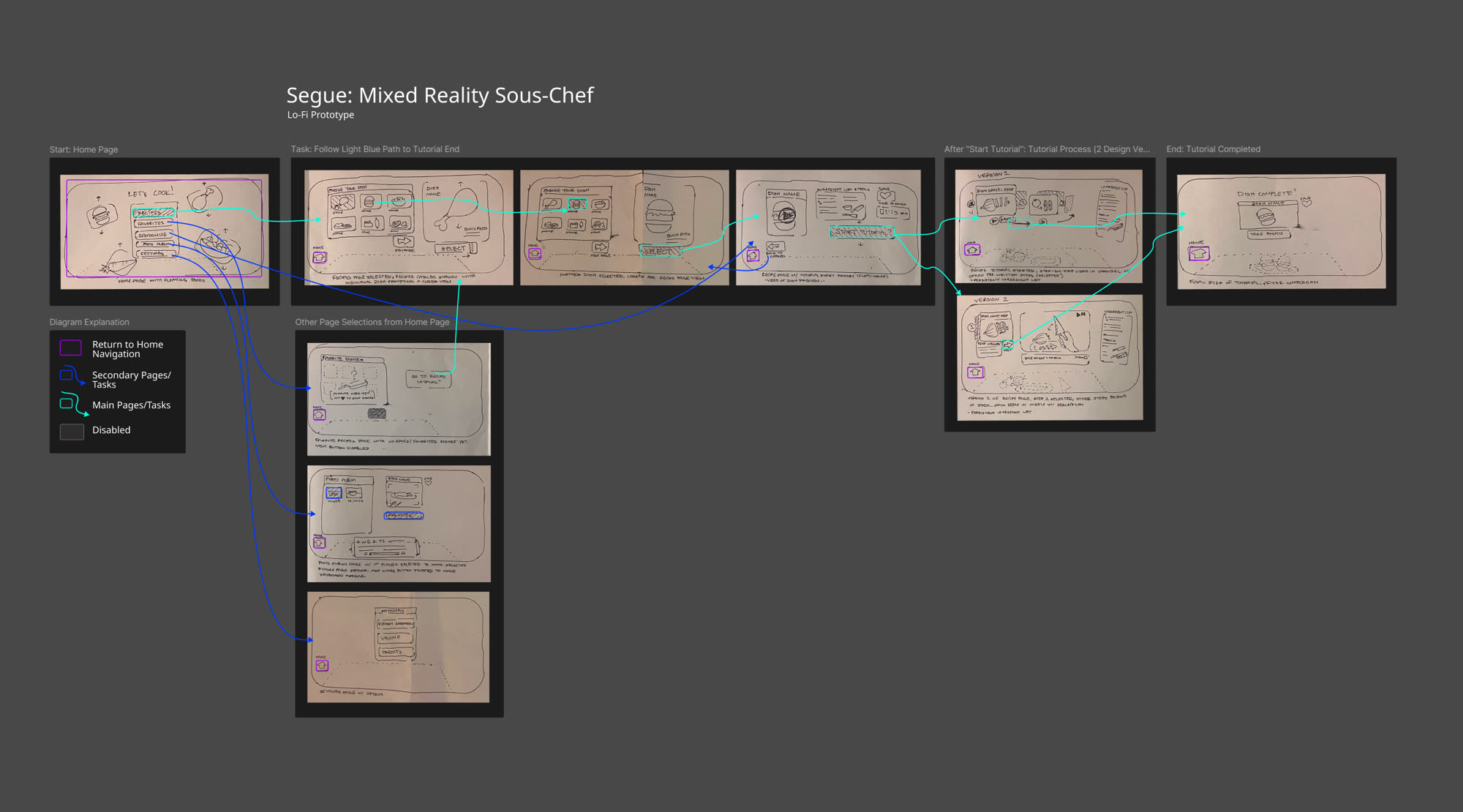
Low fidelity
Defining flow through low fidelity
In low fidelity, I kept the recipe instructions as the top-level flow, the longest but most direct path, to match the personas' pain points. The photo album and settings are secondary flows. At this stage the app was named Segue for the seamless move from step to step.
Input design
Komee's goal was to be hands-free, so I built on the HoloLens 2's standard gaze, hand gestures and palm menus. Selecting takes a pinch or a three-second stare, long enough to rule out accidents, with sounds and highlights confirming every action.
Figma can't track a hand or a gaze, so I simulated them: hover-triggered sections stand in for gestures, like raising a hand to open a palm menu.
GazeLook to aim, stare for about three seconds to select.
GestureAim with a palm ray, pinch to select.
Palm menuPalm up for home, settings and volume.
Testing and iteration
In remote usability testing with about five people per round, I first let them try the mid-fidelity Figma prototype without instructions, then gave them specific tasks. They couldn't find hidden interactions like palm menus, struggled with navigation and flow, and made more errors. The home page also didn't feel unique to the app.
I then audited the design against Nielsen's heuristics, alongside what testers reported, and fixed what it broke:
Heuristic audit5 of 5 fixed
System statusThere was no sign of how many recipe steps there were.
User controlTyped notes in the photo album couldn't be deleted.
ConsistencyPalm menus, not buttons, are the standard way home in MR.
EfficiencyPalm menus give shortcuts to settings and volume.
HelpNothing explained the app or its controls.
The final prototype
Hundreds of smart animations later, a second round of testing showed easier navigation and faster tasks, and testers reached the end of the flow without my help. Refined color and branding, cleaner margins and edited content followed.
I renamed it Komee, a play on commis, French for a chef's assistant. It's simpler to say, playful, and avoids any thought of the infamous Segway scooter.
What I've learned
Make it real, fast, and break it earlyI prototyped in Figma first, but it couldn't show the hand and gaze interactions that only exist on the HoloLens 2. Hidden interactions like palm menus were where people got stuck, and some of the first pitfalls came from testers who couldn't try it on the actual headset. Bringing the vision to the device sooner would have made my usability testing richer.
Systems thinking pays for itselfI built a style guide of reusable components: the viewport, the hex value of every element, the holographic hands, and titles and subtitles borrowed from the HoloLens assets so Komee stayed true to the platform. It made every new component easier to design.